
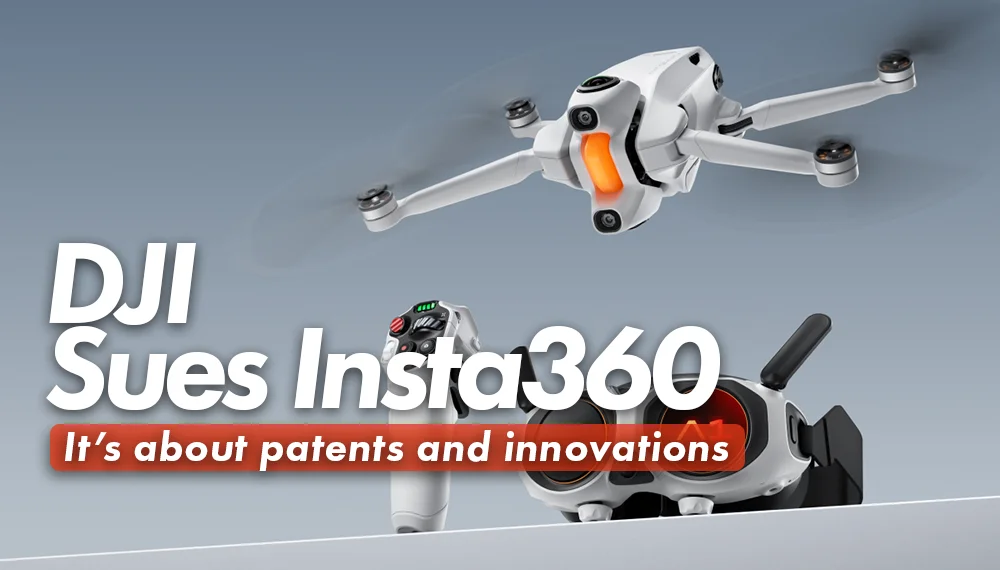
DJI has filed a patent infringement lawsuit against Insta360 in the Shenzhen Intermediate People’s Court, claiming six patents related to drone flight control, image processing, and hardware design rightfully belong to DJI. The case was reported by South China Morning Post and multiple Chinese outlets on March 23, 2026.
The timing isn’t subtle. DJI filed the lawsuit just three days before it’s set to unveil the Avata 360, its first purpose-built 360-degree drone and a direct competitor to Insta360’s Antigravity A1.
Table of Contents
What DJI Is Claiming
The core of DJI’s argument comes down to people, not products.
DJI alleges that former employees who left the company and joined Insta360 (which operates under parent company Arashi Vision) within one year went on to file patents based on work they’d been doing at DJI. Under Chinese intellectual property law, innovations created within one year of leaving a company, if they’re related to the employee’s prior duties, legally belong to the original employer.
That’s not an obscure technicality. It’s a well-established principle in Chinese patent law, and it gives DJI a clear legal basis for its claims. The six patents in question span drone flight control systems, structural design, and image processing, all areas where DJI has deep, documented expertise.
DJI also pointed to what it considers suspicious behavior: some patent filings listed inventors as “anonymous” in Chinese applications but disclosed their real names in international filings. For DJI, this looks like an attempt to hide the connection between these inventors and their former employer.
Why DJI’s Case Has Weight
Let’s set aside the corporate drama for a moment… The legal foundation here is quite straightforward.
The one-year rule is specific and enforceable
Chinese patent law doesn’t require DJI to prove that employees literally copied their old work. If the patents cover subject matter related to what those employees were working on at DJI, and they were filed within a year of their departure, the law tilts in DJI’s favor. The burden is on Insta360 to demonstrate that the innovations were genuinely independent.
The technical overlap is hard to ignore
Flight control algorithms, image processing pipelines, and hardware design are DJI’s bread and butter. When engineers who spent years developing these exact systems at DJI move to a competitor and then file patents in the same domains, the circumstantial evidence writes itself.
The anonymous inventor filings raise questions
Even if Insta360’s explanation, that hiding inventor names is a standard anti-headhunting practice, is true, it doesn’t look great when those hidden names happen to be former DJI employees. Perception matters in court.
Insta360’s Response
Insta360 founder JK Liu didn’t stay quiet. In a detailed Weibo post, he pushed back hard on every point.
On the patents themselves, Liu says the evidence shows “all ideas and innovations were independently created at Insta360.” He singled out the most significant flight control patent, a feature that enables an FPV-style “building dive” with one button press, and claimed it was his own idea, not something inherited from DJI engineers. He added that the feature was never even implemented due to flight restrictions.
On the anonymous filings, Liu called it standard practice across all Insta360 patent applications, not something targeted at hiding ex-DJI employees. “If our motive were as DJI claims, we wouldn’t have used these names at all,” he argued.
On timing, Liu pointed out that most of the patents in question were filed over four years ago and many are no longer relevant to Insta360’s current product roadmap.
Then Liu went on offense. He claimed Insta360 had identified 28 of its own patents that DJI products could potentially infringe, covering hardware, software, control methods, and accessories, but chose not to sue. “As a smaller company with limited resources, we prioritize innovation over litigation,” Liu said.
The Bigger Picture
This lawsuit didn’t happen in a vacuum. DJI and Insta360 have been circling each other for years, but the competition turned direct in 2025. DJI entered Insta360’s territory with the Osmo 360 camera. Insta360 pushed into DJI’s airspace through Antigravity, its drone sub-brand. Both companies compete aggressively in the action camera market.
It’s also worth noting what happened last month: the US International Trade Commission ruled completely in Insta360’s favor in a patent dispute brought by GoPro. That victory may have emboldened Insta360, but it may also have motivated DJI to make its own move before the competitive landscape shifts further.
Arashi Vision’s stock dropped nearly seven points after the lawsuit was made public. DJI is privately held, so there’s no equivalent market reaction to gauge.
What Happens Next
The case is now in the hands of the Shenzhen Intermediate People’s Court. Evidence collection and investigation will take time. Liu himself acknowledged this is “common in tech” and urged patience.
Meanwhile, both companies are pushing forward. DJI launches the Avata 360 on March 26. Insta360 says it has seven to eight new products coming this year, including a drone.
The court will ultimately decide whether DJI’s patents were developed independently at Insta360 or carried over by former employees. But regardless of the ruling, one thing is clear: the days when these two companies could coexist in adjacent markets are over. They’re fighting for the same customers now, and this lawsuit is just the opening move.
Sources: South China Morning Post, PetaPixel, DroneDJ, Digital Camera World