
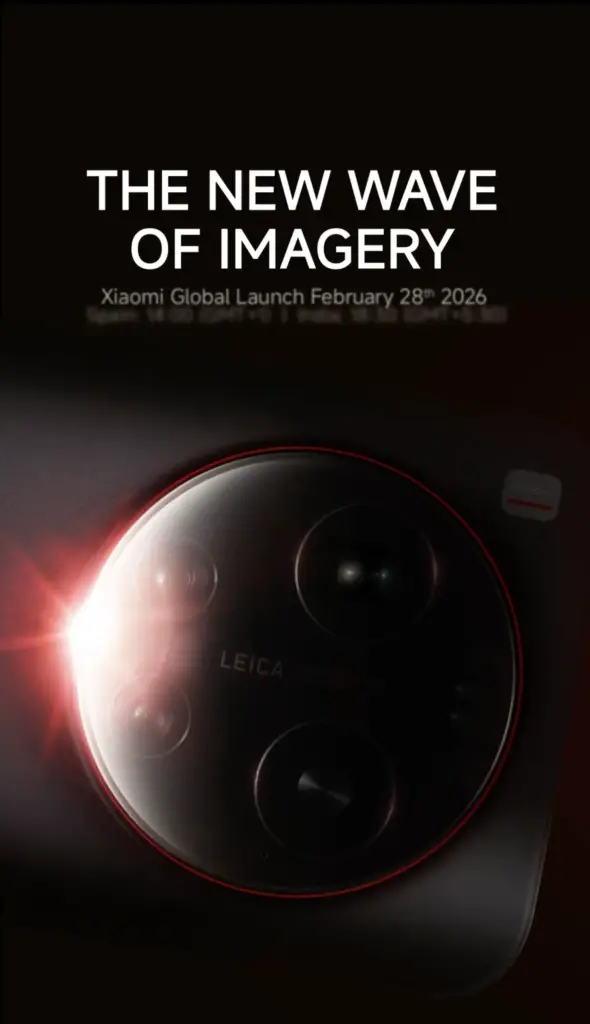
Xiaomi just confirmed what the rumor mill has been churning for weeks: the Xiaomi 17 series, including the camera-centric 17 Ultra, is getting a global launch on February 28 in Barcelona … right before Mobile World Congress kicks off. The tagline? “The New Wave of Imagery is arriving.” When a phone maker leads with imagery, photographers should pay attention. The teaser image has a Leica logo in the camera circle.
Table of Contents
What’s Coming
The global event will debut at least two phones: the standard Xiaomi 17 and the flagship Xiaomi 17 Ultra. A handful of accessories are also expected, including the Xiaomi Pad 8 Pro, Xiaomi Tag (an AirTag competitor), and the Xiaomi Watch 5. More information here.
Notably absent from the global lineup: the Xiaomi 17 Pro and Pro Max, which appear to be staying China-exclusive for now. That rear screen on the Pro Max — which lets you use the main cameras for selfies — won’t be making it to international markets. A shame for mobile photographers who’d love that feature, but the Ultra has plenty to offer on its own.
Why the Xiaomi 17 Ultra Matters for Mobile Photography
The Xiaomi Ultra line has consistently pushed smartphone camera boundaries. The previous generation, the Xiaomi 14 Ultra and 15 Ultra, earned serious respect among mobile photographers for two reasons: Leica-tuned optics and genuinely versatile multi-lens systems.
While Xiaomi hasn’t revealed the full camera specs for the global 17 Ultra yet, the Chinese version — which launched earlier — gives us a clear picture of what to expect:
- Primary sensor: 50MP with a large 1-inch-class sensor (likely the Sony IMX9-series or Samsung ISOCELL equivalent)
- Telephoto reach: Dual telephoto lenses covering multiple focal lengths, giving you optical zoom options that rival dedicated cameras
- Leica partnership: Continues the collaboration that began with the Xiaomi 12S Ultra, bringing Leica’s color science and lens profiles to the phone
- Manual controls: Xiaomi’s camera app has steadily improved its pro mode, offering RAW capture, manual focus, and exposure controls
The “New Wave of Imagery” tagline suggests Xiaomi is doubling down on computational photography features: expect AI-driven scene detection, improved night mode, and possibly new video capabilities.
The Battery Compromise
There’s one catch for international buyers. The global versions of both phones will ship with smaller batteries than their Chinese counterparts:
| Model | China Battery | Global Battery |
|---|---|---|
| Xiaomi 17 | 7,000 mAh | 6,330 mAh |
| Xiaomi 17 Ultra | 6,800 mAh | 6,000 mAh |
That’s roughly a 10-12% reduction. For photographers, battery life matters; especially when you’re shooting RAW (does the camera do that), recording 4K video, or running editing apps in the field. The 6,000 mAh on the Ultra is still substantial compared to most flagships, but it’s worth noting the difference.
Pricing: Holding the Line
Early rumors suggest Xiaomi is keeping prices identical to the previous generation in Europe, which would make the 17 Ultra one of the most competitive camera phones in its bracket. For context, the Xiaomi 14 Ultra launched at around €1,499 in Europe, significantly less than the Samsung Galaxy S25 Ultra or iPhone 16 Pro Max at comparable storage tiers.
If Xiaomi delivers improved optics at the same price point, the 17 Ultra could be the best value proposition for anyone who wants a serious camera that also happens to be a phone.
What to Watch For
When the full specs drop on February 28, here’s what mobile photographers should look out for:
- Sensor details. Is it a new sensor or an iterative improvement? A bigger sensor or higher pixel count doesn’t always mean better photos. Look for improvements in dynamic range and low-light performance.
- Zoom range. The periscope telephoto is where smartphone cameras have been making the biggest strides. How far can the 17 Ultra reach optically before digital zoom takes over?
- Video capabilities. 8K recording is becoming standard, but what about frame rates at 4K? Stabilization improvements? LOG profiles for color grading?
- Software features. Xiaomi’s computational photography has improved dramatically. Look for new AI features that go beyond gimmicks, real improvements to HDR processing, night mode, and portrait rendering.
- Accessory ecosystem. Previous Ultra models offered clip-on lens filters and photography grip accessories. If Xiaomi expands this ecosystem, it further positions the phone as a genuine photography tool.
Our Take
The Xiaomi Ultra line represents something important in mobile photography: a genuine alternative to the Apple-Samsung duopoly for photographers who take their phone cameras seriously. Xiaomi’s willingness to put large sensors, quality optics, and manual controls into a smartphone, at a lower price than its competitors, makes it worth paying attention to every year.
We’ll have full coverage once the specs are official on February 28. In the meantime, if you’re considering upgrading your mobile photography setup in 2026, the Xiaomi 17 Ultra should be on your shortlist.
Source: GSMArena