
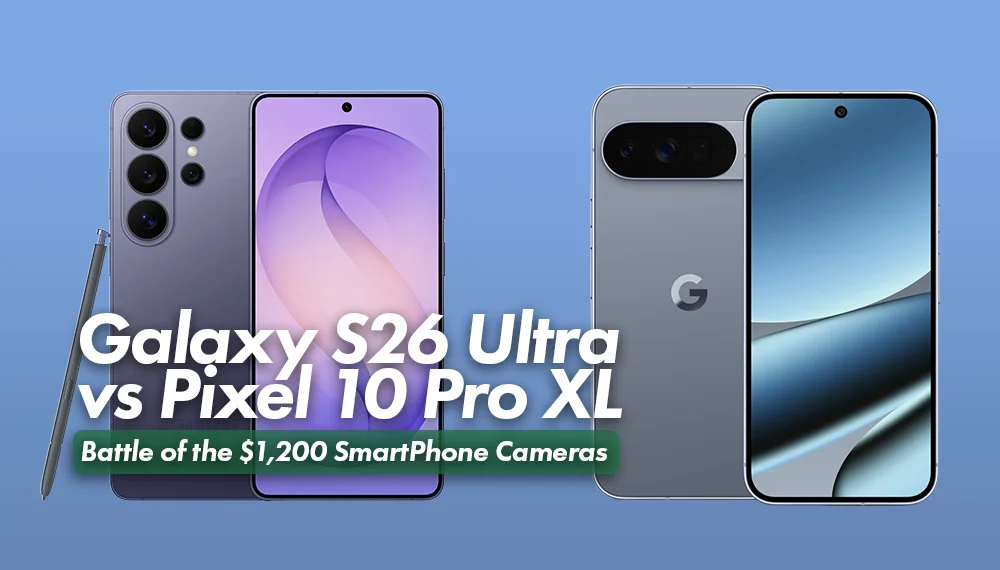
If you are shopping for a flagship Android phone in 2026 and you care about photography, the choice comes down to two very similar-looking cameras wrapped around two very different philosophies. Samsung’s Galaxy S26 Ultra and Google’s Pixel 10 Pro XL are now both on shelves, both carrying $1,199 to $1,299 price tags, and both packing triple rear camera systems built around the same sensor sizes. On paper, they look like siblings. In practice, they hand you completely different photos of the exact same scene. We dug into the specs and the real-world samples so you can figure out which one belongs in your pocket.
Table of Contents
What’s New
Samsung’s Galaxy S26 Ultra launched in early 2026 as the first Android flagship to ship with the Snapdragon 8 Elite Gen 5 for Galaxy chip, along with a new 200MP main camera and Samsung’s Gorilla Glass Armor 2 front panel. It weighs 214 grams, measures 7.9mm thick, and runs One UI 8.5 on top of Android 16. The S Pen is still in the box.
The Pixel 10 Pro XL, which Google shipped a few months earlier, runs the new Tensor G5 chip, built on TSMC’s 3nm process and tuned specifically for Google’s on-device AI features. It is slightly heavier at 232 grams and a touch thicker at 8.5mm, but it is also the cheaper of the two at $1,199 starting, compared to Samsung’s $1,299. Google went hard on display brightness this generation, and the Pixel’s screen measures over 2,200 nits in real-world testing, well ahead of the S26 Ultra’s roughly 1,400 nits in the same conditions.
Here is the surprise nobody saw coming from Samsung. Pre-launch rumors pegged the S26 Ultra as carrying a four-camera rear setup with both a 3x and a 5x telephoto, matching the S25 Ultra before it. The shipping phone does not. Samsung quietly dropped the 3x module, leaving the S26 Ultra with the same three-lens layout as the Pixel 10 Pro XL: a main camera, an ultrawide, and a single 5x telephoto. That is a meaningful simplification for a phone that has historically leaned on its versatile zoom range as a differentiator.
Key Specifications
| Spec | Galaxy S26 Ultra | Pixel 10 Pro XL |
|---|---|---|
| Main camera | 200MP, 1/1.3″ sensor | 50MP, 1/1.3″ sensor |
| Ultrawide | 50MP, 1/2.5″, AF | 48MP, 1/2.5″, AF |
| Telephoto | 5x, ~100mm, 1/2.5″ | 5x, ~100mm, 1/2.5″ |
| Selfie | 12MP, 23mm equivalent | Quad Bayer, 18mm ultrawide |
| Max video | 8K at 30fps | 8K at 30fps |
| Display | 6.9″ LTPO OLED, ~1,400 nits measured | 6.8″ LTPO OLED, ~2,265 nits measured |
| Chipset | Snapdragon 8 Elite Gen 5 for Galaxy | Google Tensor G5 |
| Battery | 5,000 mAh | 5,200 mAh |
| Wired charging | 60W | 45W |
| Wireless charging | 25W (case with magnets required) | 25W Qi2.2 Pixelsnap (built-in magnets) |
| Weight | 214 g | 232 g |
| Starting price | $1,299 | $1,199 |
Why It Matters for Mobile Photographers
Here is where the spec sheet stops telling the story. Both phones use 1/1.3-inch main sensors. Both telephotos are the same 5x focal length on the same 1/2.5-inch sensor size. On paper, these should produce nearly identical images. They do not, and the differences are not subtle once you know where to look.
The main camera gap is a resolution philosophy, not a hardware gap. Samsung’s 200MP main bins pixels down to 12.5MP or 50MP outputs by default, using the extra resolution for digital zoom and detail-lifting. Google’s native 50MP main reads out the full sensor every shot and leans on its computational pipeline to do the heavy lifting. In daylight, the Samsung often shows more fine detail in textures like foliage and fabric, while the Pixel produces cleaner gradients and more natural skin tones. If you are shooting portraits or editorial work, the Pixel’s rendering is the safer bet. If you want maximum detail for landscapes or street photography where you might crop in later, the Galaxy has an edge.
Zoom is a split decision. At 3x, where both phones are cropping from their main sensors (remember, neither has a dedicated 3x module now), the Pixel is slightly sharper. At 5x, both optical telephotos deliver roughly the same level of detail, though the Samsung leans yellow-warm and the Pixel stays neutral, sometimes slightly pink. Push to 10x and the Galaxy pulls ahead noticeably in bright outdoor scenes thanks to its aggressive detail reconstruction, but indoors the gap closes and both phones produce soft, digitally rendered images. Neither is winning any awards at 10x, but if you shoot wildlife or concerts from a distance in daylight, the Galaxy is the phone you want.
Low light is where the Pixel’s reputation holds up. Samsung’s night mode has been unreliable across the review cycle, occasionally overexposing skies and crushing shadow detail in ways that earlier Ultras did not. The Pixel 10 Pro XL is more consistent in the dark, particularly at the telephoto end where noise tends to dominate. If you shoot concerts, restaurants, or night street scenes, the Pixel is the safer pick.
Ultrawide is a coin flip. The Pixel is marginally sharper in the center of the frame but softer at the edges. The Galaxy is more uniform across the frame but slightly less detailed overall. Real-world ultrawide shots look equally good from both, and you would struggle to pick a winner without pixel-peeping.
Selfies are where the Pixel genuinely wins. Its 18mm-equivalent ultrawide front camera is a real advantage for group selfies, travel photos where you want context behind you, and vlogging. The Galaxy’s 23mm selfie is tighter and better for standard portraits but cannot fit a crowd. If selfies matter to you, the Pixel is not close.
Video shakes out similarly. Both phones shoot 8K at 30fps, but in practice most people will spend their time at 4K. The Pixel has a sharpness advantage in ultrawide video and at 1x. Both phones stumble badly at 2x video, which is digital zoom from the main sensor on both. The Galaxy reclaims the lead at 3x, 5x, and 10x video, where its telephoto pipeline is cleaner throughout the zoom range. Vloggers and travel creators who lean wide should go Pixel. Anyone shooting at a distance should go Galaxy.
Our Take
If the cameras really were identical, this would come down to software preference and that extra $100 in the Pixel’s favor. They are not identical, though, and the split is cleaner than the spec sheet suggests.
Pick the Galaxy S26 Ultra if: you want the absolute best daylight detail, you shoot at distance more than at close range, you actually use the S Pen, and you do not mind paying more for a phone with marginally worse battery life and a dimmer screen. The 60W wired charging is also a real quality-of-life win if you are constantly topping up between shoots.
Pick the Pixel 10 Pro XL if: you shoot a lot of portraits, selfies, or low-light scenes; you want built-in Qi2.2 magnetic charging without needing a special case; you prefer cleaner, more natural color rendering; and you would rather save the $100. The brighter screen also matters if you edit photos outdoors.
Neither phone is a clean winner, and both are genuinely strong mobile photography tools. But the quiet change that stands out is Samsung dropping the 3x telephoto. For a phone that has historically differentiated itself on versatile zoom, the S26 Ultra is now playing the same three-lens game as everyone else. That makes the Pixel 10 Pro XL, which costs a hundred dollars less, feel like a better value than it has any business being. For most mobile photographers, the Pixel is the phone we would recommend. For the specific shooters who need that daylight detail or long-range zoom, the Galaxy still earns its spot.
Sources:
- GSMArena, “Samsung Galaxy S26 Ultra vs. Google Pixel 10 Pro XL” (April 7, 2026): https://www.gsmarena.com/samsung_galaxy_s26_ultra_vs_google_pixel_10_pro_xl_review_battery_camera_price_compared-news-72143.php
- Phandroid, “Galaxy S26 Ultra vs Pixel 10 Pro XL: same price, completely different” (February 25, 2026): https://phandroid.com/2026/02/25/galaxy-s26-ultra-vs-pixel-10-pro-xl-same-price-completely-different/